Steel Trawler Conversion: From Neglected Vessel to 60-Foot Liveaboard Cruiser
Jump to: Acquisition | Demolition | Exterior & Steel Work | Stern Deck | Structural Modifications
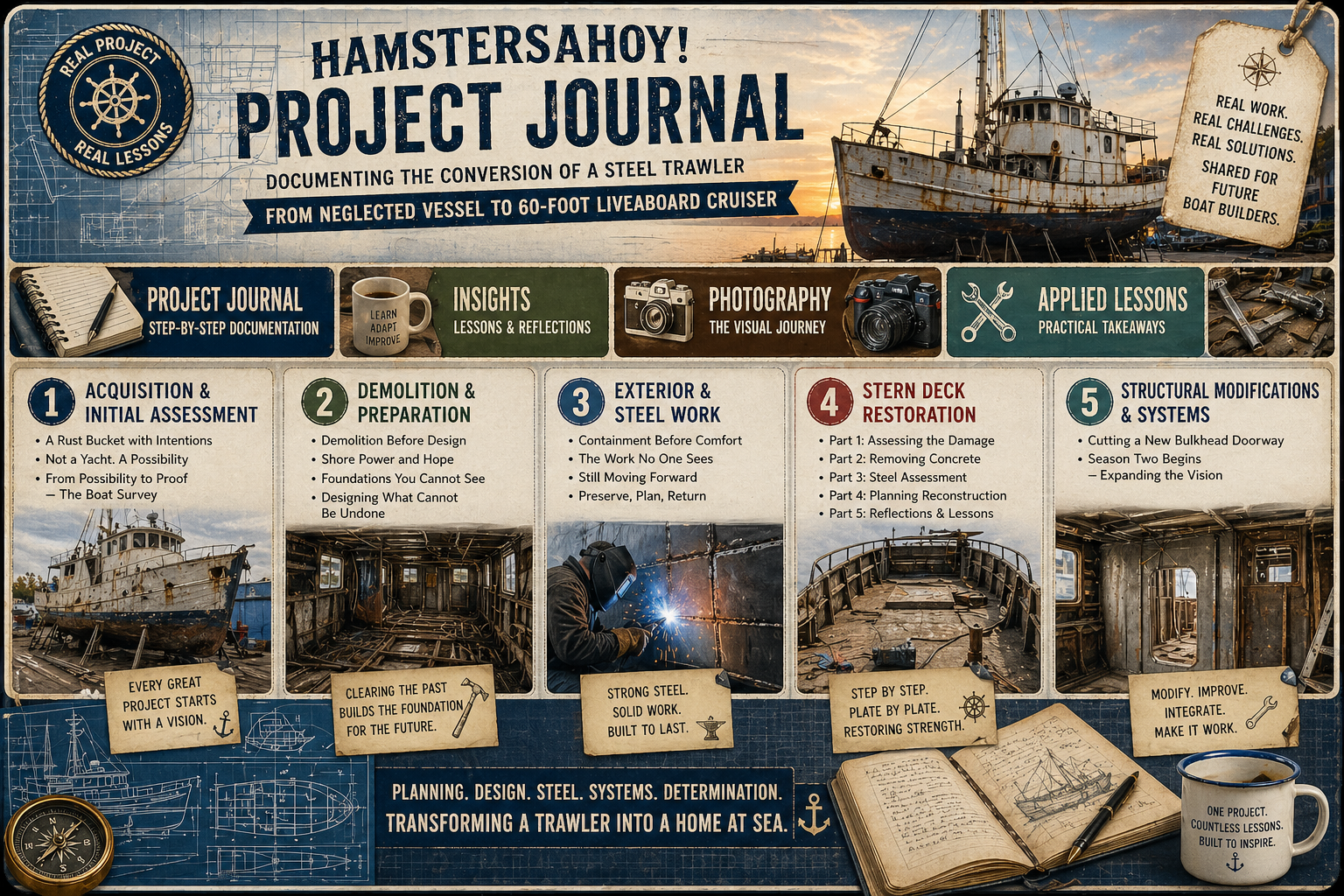
This hub documents the full steel trawler liveaboard conversion from a neglected 48-foot vessel to a fully rebuilt 60-foot coastal cruiser. Explore detailed articles on planning, structural steel repair, deck restoration, systems upgrades, and liveaboard design. Whether you’re a boat builder, aspiring liveaboard, or marine restoration enthusiast, this guide offers practical lessons from a real-world project.
1. Acquisition and Initial Assessment
- A Rust Bucket with Intentions – Rebuilding a 1980s Steel Trawler into a 60-Foot Liveaboard Coastal Cruiser – How a neglected vessel became the foundation for a long-term liveaboard refit project.
- Not a Yacht. A Possibility – Why a Neglected Steel Trawler Replaced a Westsail 40 – Choosing the right vessel based on potential, practicality, and design.
- From Possibility to Proof – The Boat Survey That Measured Reality – Insights from the survey process uncovering the true condition of hull, structure, and systems.
2. Demolition and Preparation
- Demolition Before Design – Clearing the Past to Understand the Work Ahead – Removing old components to make way for structural upgrades.
- Shore Power and Hope – Discovering the True State of the Boat’s Systems – Evaluating electrical and mechanical systems to plan marine restoration.
- Foundations You Cannot See – Frames, Decks, and the Work That Makes Everything Else Possible – Examining hidden structural steel that ensures long-term stability.
- Designing What Cannot Be Undone – Systems Architecture and the End of Escape Routes – Planning integrated systems balancing comfort, safety, and maintainability.
3. Exterior and Steel Work
- Containment Before Comfort – Rebuilding the Exterior to Survive the Coming Cold – Preparing the hull and superstructure for winter and long-term durability.
- The Work No One Sees – Stripping Insulation and Preparing Steel for What Comes Next – Steel preparation techniques for high-quality structural steel repair for boats.
- Still Moving Forward – Cold Steel, Shortening Days, and Measured Progress – Reflections on pacing, milestones, and staying motivated during winter.
- Preserve, Plan, Return – How Winter Shapes the Pace of a Liveaboard Refit – Seasonal planning and strategies for uninterrupted progress.
4. Stern Deck Restoration
This multi-part series dives into restoring the stern deck, detailing assessment, steel repair, concrete removal, and reconstruction:
- Bringing the Stern Deck Back to Life – Part 1: Assessing the Damage and Planning the Work
- Bringing the Stern Deck Back to Life – Part 2: Removing the Concrete Topping
- Bringing the Stern Deck Back to Life – Part 3: Steel Assessment and Rejuvenation
- Bringing the Stern Deck Back to Life – Part 4: Planning for Deck Reconstruction
- Bringing the Stern Deck Back to Life – Part 5: Reflections and Lessons Learned
5. Structural Modifications and Systems
- Cutting a New Bulkhead Doorway in a Steel Liveaboard: Safe Solo Welding Methods for UK Boat Projects – Step-by-step guide for modifying bulkheads safely.
- Season Two Begins – Rebuilding a 48ft Trawler into a 60ft UK Liveaboard Cruiser – Updates on expansion, new challenges, and lessons learned for ongoing liveaboard refit.
By following this hub, readers gain a complete view of the conversion journey, from initial survey and demolition to steel work, deck restoration, and liveaboard readiness. Whether you are a boat builder, aspiring liveaboard, or marine restoration enthusiast, this series provides a detailed, step-by-step guide to transforming a steel trawler into a seaworthy home.
The Boat
The vessel at the centre of this project is a steel trawler-type liveaboard, built in the early 1980s — most likely 1983 — and originally intended for coastal working life rather than leisure. Her early years appear to have been spent on the River Severn and the Bristol Channel, operating as a practical, inhabited vessel rather than a cruiser in the modern sense.
Log #01 - First Sight
November 2024 - Winter
I first saw the boat in November 2024, in winter, which is rarely when anything looks its best and is therefore an excellent time to look seriously.
Log #02 - The Survey
March 2025 — Early Spring
A few weeks after we committed to pursuing the boat — brought the first professional evaluation. The excitement of discovery had settled into a more deliberate frame of mind: careful observation, note-taking, and planning.
Log #03 - Strip-Out & Discovery
April 2025 — Spring
The boat was finally in our hands and ownership brought immediacy: the surveys had been done, the decisions made, and the first real work now awaited.
Log #04 - Systems Assessment (or What Was Left of Them)
May 2025 — Late Spring
With the interior largely cleared, it was time to look at the boat’s systems. This was where optimism met reality. The engine only seemed complete. Components were present, yes, but their condition and connectivity remained uncertain. It would require careful inspection — and likely significant rebuilding — before we could even consider running her independently.
Log #05 - Interior Steelwork & Deck Preparation
Summer 2025 - Early Summer
With systems assessed, attention turned to the internal steelwork and foredeck preparation. The stripped-out spaces revealed missing or weakened frames that needed urgent attention. Each section of internal hull steel was cleaned, treated, and welded where necessary.
Log #06 - Drawing the Line
Summer 2025 - Mid Summer
There comes a point in any long project where the question stops being “Can this be done?” and becomes “How exactly will it be done?” For this boat, that point arrived once the structural work was underway and the scale of the refit fully understood.
Log #07 - Hull, Roof & Saloon: Racing Against Winter
Summer 2025 - Late Summer
With strip-out complete and systems assessed, focus shifted decisively to the exterior hull, saloon walls, and roof. Reality — and the weather — dictated the order: nothing internal could be addressed until the structure above and around it was secure.
Log #08 - Insulation, Steel, and Shortening Days
Autumn 2025 - Early Autumn
With the exterior envelope stabilised — the hull protected, the saloon walls rebuilt, and the roof braced — the character of the work changed.
Log #9 - Framework, Graft, and the Arithmetic of Effort
Late Autumn 2025 - Mid Autmn
By this point it was clear that the work was no longer difficult in a technical sense. It was difficult in a physical and temporal one.
Log #10 - Winter Shutdown
Mid-November 2025 - Early Winter
Winter had made the decision for us. Night-time temperatures were consistently around minus two to minus four. Ice formed on the inside of windows. It was damp, dreary and daylight had shrunk to the point where meaningful progress was measured in minutes rather than hours.
Log #11 - A Measured Re-Awakening
Mid-February 2026 - Awaiting Spring
Winter did not stop the project. It clarified it.
Night temperatures sat stubbornly below freezing. Rain persisted. Daylight was rationed. The sensible decision was to pause. Not because progress had failed, but because forcing it would have created rework, risk, and frustration.
Cutting a New Bulkhead Doorway in a Steel Liveaboard: Safe Solo Welding Methods for UK Boat Projects
Log #12 – Forward Structure & A Lesson in Not Struggling
Late February 2026 – Stourport-on-Severn
We returned to the boat on 21st February, nearly a month earlier than last year’s start. That single month made a remarkable difference. The yard was still damp, still cold, still honest — but it was workable.
Log #13 - Restoration in Action
Beginning March 2026 - After The Wettest Winter On Record (according to local radio)
Welcome to the comprehensive series documenting the restoration of a steel boat stern deck. This step-by-step guide covers everything from initial assessment to reflections and lessons learned, providing valuable insights for boat owners and restorers.
Log #14 - Restoration in Action
Beginning March 2026 - After The Wettest Winter On Record (according to local radio)
The stern deck of any boat is more than just a flat surface; it is the structural and functional heart of the aft section. For a steel-hulled vessel like mine, the stern deck bears not only the physical load of the deck itself but also the dynamic stresses of the hull in motion, rigging, and crew activity. Over the years, maintenance decisions, neglect, or improvisation can leave a lasting mark, and in the case of my boat, the cumulative effect of past interventions became painfully evident.
Log #15 - Restoration in Action
Beginning March 2026 - After The Wettest Winter On Record (according to local radio)
After completing a thorough assessment of the stern deck and reinforcing the deckhead below, the next major step in restoring the stern deck is the removal of the "concrete" topping. This seemingly simple layer presents more challenges than its modest thickness suggests. Though only 5 mm to 10 mm thick in most places, it is uneven, partially adhered, and brittle in spots, which makes careful removal essential. This article details the step-by-step process, practical considerations, and lessons learned while tackling this critical stage.
Log #16 - Restoration in Action
Beginning March 2026 - After The Wettest Winter On Record (according to local radio)
With the concrete topping removed from the stern deck, the underlying steel framework is fully exposed, ready for detailed assessment and rejuvenation. This stage is critical: the longevity and structural integrity of the deck depend on accurately identifying compromised areas, restoring recoverable steel, and replacing sections where deterioration is too severe. In this article, I outline my process for inspecting the steel, deciding what to repair versus replace, and the techniques I use to rejuvenate it.
Log #17 - Restoration in Action
Beginning March 2026 - After The Wettest Winter On Record (according to local radio)
With the stern deck cleared of concrete and the steel framework fully assessed, repaired, and rejuvenated, the project moves into the critical planning phase for deck reconstruction. This stage involves evaluating suitable materials, determining methods of integration with the steel, and preparing the surface for installation. Proper planning here ensures that the restored stern deck will be durable, lightweight where necessary, and resistant to future corrosion or structural issues.