
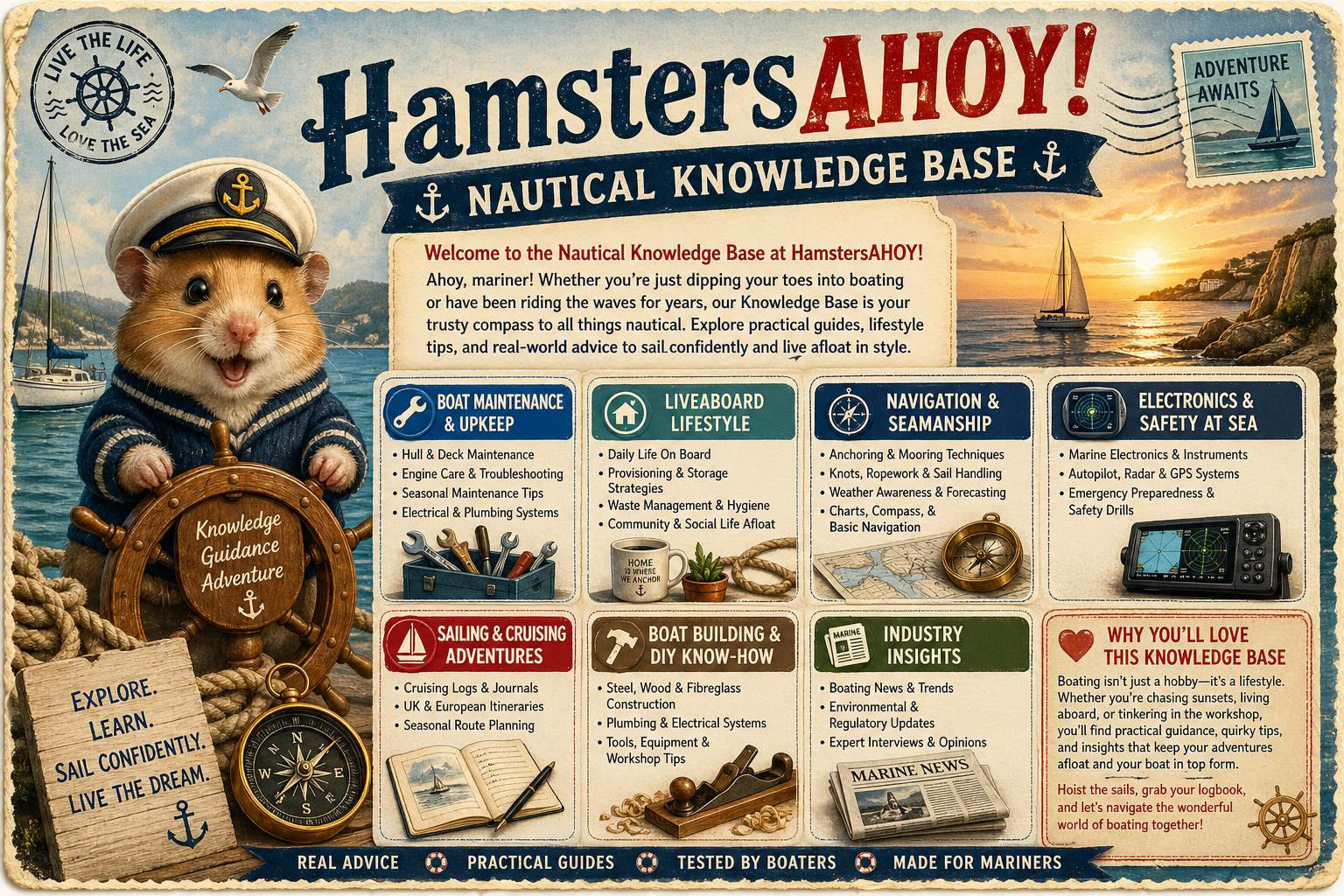
Welcome to the Nautical Knowledge Base at HamstersAHOY!
Ahoy, mariner! Whether you’re just dipping your toes into boating or have been riding the waves for years, our Knowledge Base is your trusty compass to all things nautical. Explore practical guides, lifestyle tips, and real-world advice to sail confidently and live afloat in style.
What Awaits You Onboard
Boat Maintenance & Upkeep
- Hull & Deck Maintenance
- Engine Care & Troubleshooting
- Seasonal Maintenance Tips
- Electrical & Plumbing Systems
Liveaboard Lifestyle
- Daily Life On Board
- Provisioning & Storage Strategies
- Waste Management & Hygiene
- Community & Social Life Afloat
Navigation & Seamanship
- Anchoring & Mooring Techniques
- Knots, Ropework & Sail Handling
- Weather Awareness & Forecasting
- Charts, Compass, & Basic Navigation
Electronics & Safety at Sea
- Marine Electronics & Instruments
- Autopilot, Radar & GPS Systems
- Emergency Preparedness & Safety Drills
Sailing & Cruising Adventures
Boat Building & DIY Know-How
- Steel, Wood & Fibreglass Construction
- Plumbing & Electrical Systems
- Tools, Equipment & Workshop Tips
Industry Insights
Why You’ll Love This Knowledge Base
Boating isn’t just a hobby—it’s a lifestyle. Whether you’re chasing sunsets, living aboard, or tinkering in the workshop, you’ll find practical guidance, quirky tips, and insights that keep your adventures afloat and your boat in top form. Hoist the sails, grab your logbook, and let’s navigate the wonderful world of boating together!
Understanding basic seamanship is fundamental for anyone venturing onto the water, whether you are navigating calm rivers or open seas. It encompasses a range of skills and knowledge that ensure your safety, enhance your confidence, and allow you to handle your vessel efficiently. This article will guide you through the core aspects of boat handling, knot tying, navigation rules, and other essential skills every sailor or powerboater should master.
Ropework sits at the very heart of boating seamanship. Long before electronics, engines, or modern materials, mariners relied on their knowledge of rope, knots, and line handling to keep vessels secure and crews safe. Even today, in an age of GPS and automation, boat ropework remains one of the most essential skills for anyone who ventures onto the water. Whether you are a weekend sailor, a motor cruiser, or a traditional boating enthusiast, understanding ropework is fundamental to confidence and competence afloat.
Modern marine electronics do more than guide a vessel—they record data, analyse performance, and provide insights for safer, faster, and more efficient navigation. From integrated GPS and autopilot systems to radar and depth instruments, data logging allows sailors to learn from each journey and make informed decisions for future voyages.
Even the most advanced marine electronics are only as reliable as their maintenance allows. GPS units, chartplotters, autopilots, sonar, and other instruments can experience inaccuracies or failures if not regularly checked, calibrated, and serviced. This article guides boaters through essential troubleshooting, calibration, and maintenance practices to ensure consistent navigation reliability.
Modern boating is increasingly about connectivity. The true power of marine electronics emerges when systems—GPS, chartplotters, autopilots, radar, and sonar—communicate seamlessly. Integrated navigation systems allow skippers to make better decisions, reduce risk, and enhance overall efficiency on the water.
In today’s boating world, reliable electronics are indispensable for safe and efficient navigation. From the seasoned sailor to the weekend cruiser, understanding marine GPS systems, chartplotters, and other digital instruments is crucial. This article explores the core electronic tools that enhance navigation and seamanship on the water.
Electronic depth sounders are invaluable tools for boaters, providing real-time information about water depth, underwater obstacles, and the seabed. Whether paired with a fishfinder for leisure fishing or used for safe navigation, these devices integrate seamlessly with other marine electronics to enhance safe navigation on UK waters.
AIS systems (Automatic Identification Systems) have become essential tools in modern boating, offering advanced vessel tracking and collision avoidance. By transmitting and receiving information about your vessel and nearby traffic, AIS enhances situational awareness, especially in busy harbours, rivers, and open waters.
Marine autopilot systems have revolutionised boating, making long passages easier and safer. By automating steering, they allow skippers to maintain a steady course while focusing on navigation, weather, and overall vessel control. Combined with other nautical electronics, autopilot systems provide precise and reliable guidance.
In modern boating, marine radar systems play a pivotal role in collision avoidance. Whether navigating foggy estuaries, busy harbours, or open sea lanes, a well-installed radar system provides crucial situational awareness, complementing traditional navigation tools and other nautical electronics.
Marine GPS systems have become an indispensable part of modern boating. Whether you're a leisure sailor cruising along the Norfolk Broads or a professional mariner navigating the English Channel, understanding the capabilities of your GPS system can dramatically improve maritime safety and efficiency.
Navigating at night or in conditions of reduced visibility is one of the most challenging aspects of seamanship. Even experienced boaters can be caught off guard by darkness, fog, heavy rain, or haze. Collisions, groundings, and other incidents are far more likely when visibility is limited, making vigilance, preparation, and adherence to safety practices essential.
Modern electronic navigation systems have transformed boating, but they have also introduced a new vulnerability. Power failure, water ingress, software faults, or signal loss can leave a vessel suddenly without GPS, chartplotters, or electronic charts. When this happens, safe navigation depends on preparation and basic seamanship skills.
Anchoring is often seen as a routine part of boating, yet poor anchoring technique is a frequent cause of groundings, collisions, and emergency call-outs. A dragging anchor can place a vessel and crew in serious danger, particularly in crowded anchorages or when weather conditions change unexpectedly.
Pilotage is the art of navigating a vessel in close proximity to land, hazards, and other traffic. Harbours, estuaries, rivers, and marinas present some of the most demanding navigational challenges faced by recreational boaters. Despite relatively short distances, many incidents occur in confined waters due to poor preparation, loss of situational awareness, or misjudgement.
Maintaining a proper lookout and effective watchkeeping are among the most fundamental responsibilities of anyone in charge of a vessel. Many collisions, groundings, and near-misses occur not because of equipment failure or poor charts, but because hazards were simply not seen or recognised in time.
Weather is one of the most influential and least controllable factors affecting safety at sea. Even a short trip can become hazardous if conditions deteriorate unexpectedly. While modern forecasts are widely available, accidents still occur because weather information is misunderstood, ignored, or relied upon too heavily without observation.
Modern boating has been transformed by electronic navigation. Chartplotters, GPS, and mobile apps now place an extraordinary amount of information at a skipper’s fingertips. While these tools have greatly improved convenience and accuracy, they have also introduced new risks when used without sufficient understanding.
- Collision Avoidance at Sea – Understanding the COLREGs Simply and Safely
- Understanding Tides and Tidal Streams for Safer Boating
- Passage Planning for Safety at Sea – A Practical Guide for Recreational Boaters
- Navigation and Seamanship: The Foundation of Confident Boating
- Tips and Tricks for Keeping a Consistent and Useful Cruising Log