

The Cumbria Coast, extending from the Solway Firth southwards past Maryport, Whitehaven, Workington and down to Barrow-in-Furness, presents a discontinuous but persistent maritime working frontage. Its character is shaped less by continuous small fishing settlements than by a sequence of industrial and market ports separated by long stretches of tidal shore, estuary and reclaimed ground. Offshore waters are generally exposed to the Irish Sea, with the Solway in the north governed by extreme tidal range and fast-setting channels that have long influenced inshore working methods and the timing of coastal navigation.
Maritime activity here has historically been tied to extractive and export-led industries as much as to fishing. Whitehaven developed as a coal port of regional significance from the seventeenth century onwards, with shipping lanes established across the Irish Sea to Ireland and the Isle of Man. Workington and Maryport functioned as smaller coal and iron export points, supporting Cumberland’s inland mining and later steel production. At Barrow-in-Furness, deep-water access enabled large-scale shipbuilding and naval construction from the late nineteenth century, with associated dockyards dominating the town’s shoreline orientation. Alongside these industrial roles, inshore fisheries operated on a more localised scale, including drift and net fisheries for herring and whitefish, though records indicate fluctuating yields and periodic decline linked to wider Irish Sea stock movements.
In the Solway Firth, traditional estuarine practice is more distinct. Haaf netting for salmon and sea trout, conducted from fixed frames waded into tidal channels, has long been recorded on both the Cumbrian and Dumfriesshire sides, though participation has reduced significantly under regulatory constraint and stock conservation measures. Shrimping and small-scale shellfish gathering have persisted in sheltered creeks and estuarine margins, particularly where soft mudflats allow seasonal working at low water. Harbour customs in ports such as Whitehaven and Maryport historically included regulated market days for landed fish, with auction systems and informal shore-side grading carried out directly on quays or adjacent cobbled slips.
Lifeboat operations form a consistent strand of maritime continuity across the coast. Stations under the Royal National Lifeboat Institution maintain active coverage at several ports, reflecting the exposed nature of the Irish Sea approaches and the tidal hazards of the Solway. Launch procedures, exercise drills and fundraising events remain embedded in local working waterfront culture, often tied to harbour communities rather than wider civic identity. Boat handling traditions persist in small craft usage, including potting, netting and estuary navigation, although these are now largely seasonal or part-time occupations rather than full-time fisheries employment.
Modern maritime activity is more fragmented but not absent. Barrow remains significant in offshore energy and marine engineering, with fabrication and service roles linked to North Sea and Irish Sea installations. The offshore wind developments off Walney Island have reinforced port usage for support vessels and maintenance craft. Inshore shrimping and limited shellfish collection continue in suitable Solway and Cumbrian estuarine areas, though subject to licensing and environmental constraint. Recreational sailing and angling now occupy many of the smaller harbour spaces formerly used by commercial fleets, yet tidal awareness, pilotage skills and local knowledge of shifting sandbanks remain essential for safe navigation.
The present-day Cumbria Coast thus retains a maritime identity grounded in working practice rather than uniform tradition. Its ports reflect different historical phases—industrial export, naval construction, and current energy infrastructure—while the intervening shorelines preserve more modest forms of estuarine and inshore activity. Continuity is evident less in any single enduring custom than in the sustained requirement to work with strong tides, exposed approaches and the operational constraints of the Irish Sea environment.
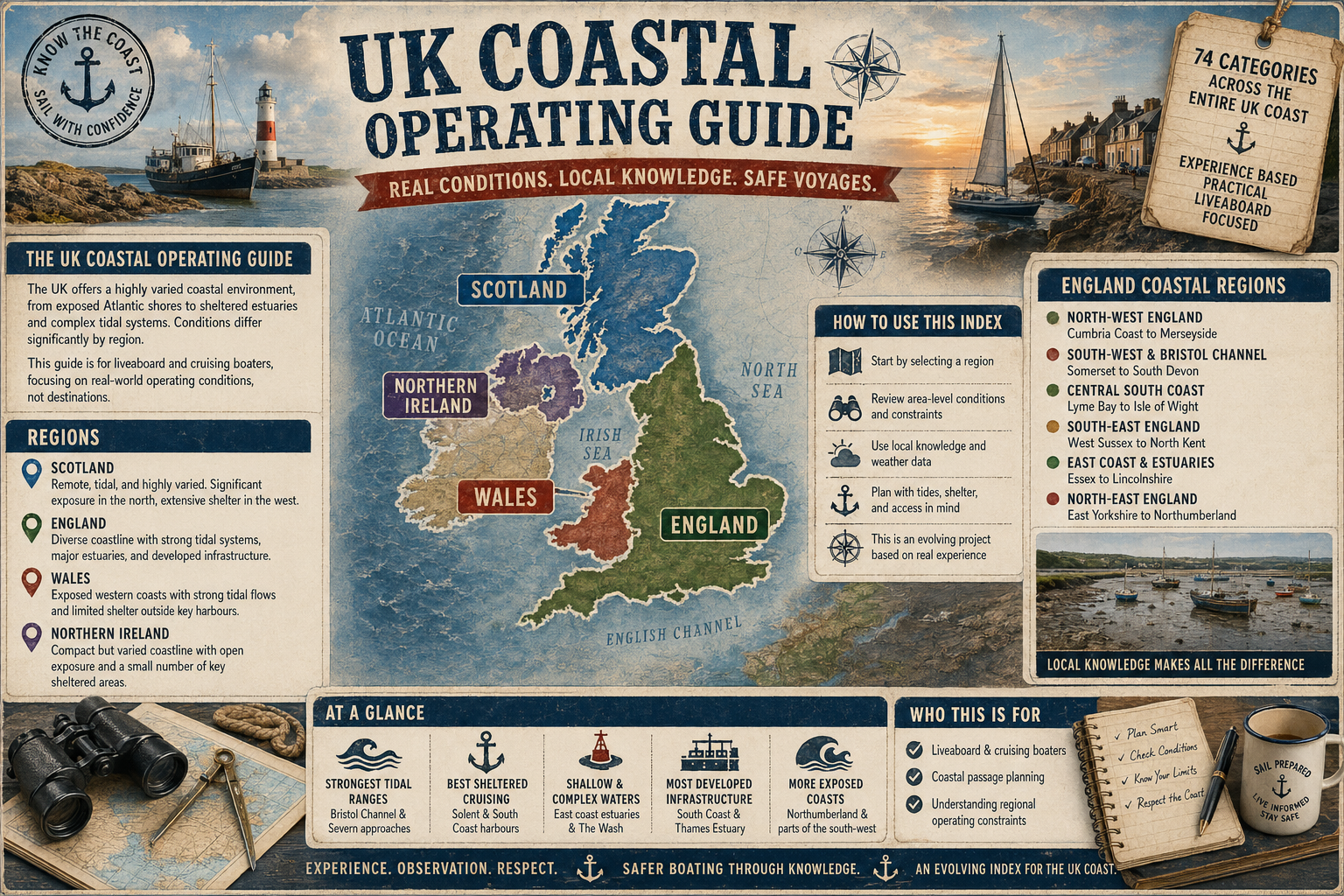
- The UK Coastal Operating Guide
- Coastal Traditions & Maritime Culture of Britain and Northern Ireland
- Coastal Myths & Legends of Britain & Northern Ireland

Comments