



The stretch of coast between Bridlington and Filey, dominated by the chalk headland of Flamborough Head, is well known to mariners for its prominent landfall, strong tidal streams and the abrupt transition between the shallow waters of Bridlington Bay and the deeper approaches of the North Sea. Within this setting there exists a modest body of local tradition, occasionally referred to in antiquarian notes and coastal lore, which makes passing reference to a dragon-like creature associated with the headland. These accounts are not uniform, nor consistently documented, and should be regarded as regional folklore rather than established narrative tradition.
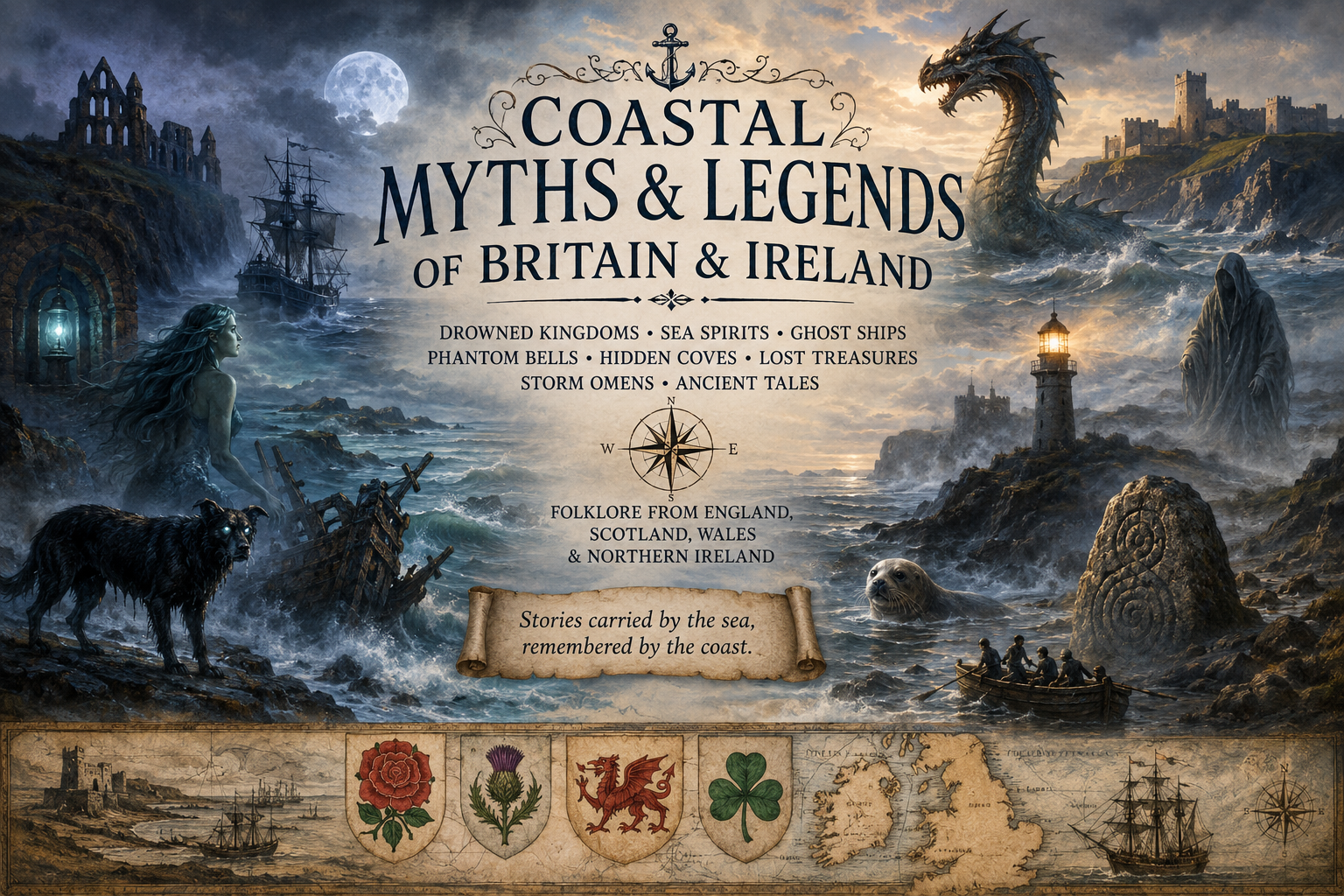
Flamborough Head itself, with its white cliffs, natural arches and sea-worn caves, has long provided material for imaginative interpretation. In earlier local storytelling, particularly in nineteenth-century compilations of coastal curiosities, there are scattered references to “dragon” or “great serpent” descriptions applied to unusual rock forms or to sightings at sea under poor visibility. It is unclear whether these accounts derive from older medieval traditions, misinterpretations of marine animals, or later embellishments attached to an already prominent navigational landmark. No single authoritative version of a Flamborough dragon legend survives in consistent form, and the association remains largely conjectural.
From a maritime perspective, such narratives are best understood in relation to the practical conditions experienced off the headland. The waters here are subject to strong tidal races, particularly where the North Sea flow meets the irregular coastline of the Holderness front. Sudden sea mists, backscatter from breaking seas over chalk ledges, and the visual distortion created by refracted light along the cliff face may have contributed to reports of unusual shapes at sea. For pilots and coastal traders working between the Humber approaches and the fishing harbours of Bridlington and Scarborough, Flamborough Head has always required careful allowance for set and drift, especially in easterly winds when overfalls develop offshore.
Local fishing communities historically placed more practical emphasis on these conditions than on any figurative interpretation, though it would not be unusual for isolated coastal communities to attach narrative explanations to distinctive topography. The headland’s caves and blowholes, which respond audibly and visibly to swell conditions, may have reinforced such associations in earlier periods when coastal geology was less well understood. However, surviving documentation does not indicate a structured or widely shared dragon cult or tale specific to Flamborough comparable to better-attested British coastal legends elsewhere.
Modern navigation through this sector relies on established aids, including Flamborough Head Lighthouse, and on standard awareness of the tidal set which can be considerable along this part of the East Riding coast. The area remains an active fishing ground and a passage route for small coastal vessels, and the emphasis in seamanship has consistently been on charted hazards rather than folkloric interpretation. Where references to dragon-like forms persist, they are generally treated as peripheral curiosities within a broader coastal narrative shaped more by geology and sea conditions than by myth.
In summary, the so-called dragon traditions of Flamborough Head occupy a minor and uncertain place within East Yorkshire coastal folklore, better understood as interpretative by-products of a visually complex and meteorologically active headland. They sit lightly upon a coastline defined in practice by tides, chalk cliffs and North Sea exposure, where navigation has always depended more on observation and experience than on inherited story.

Comments