
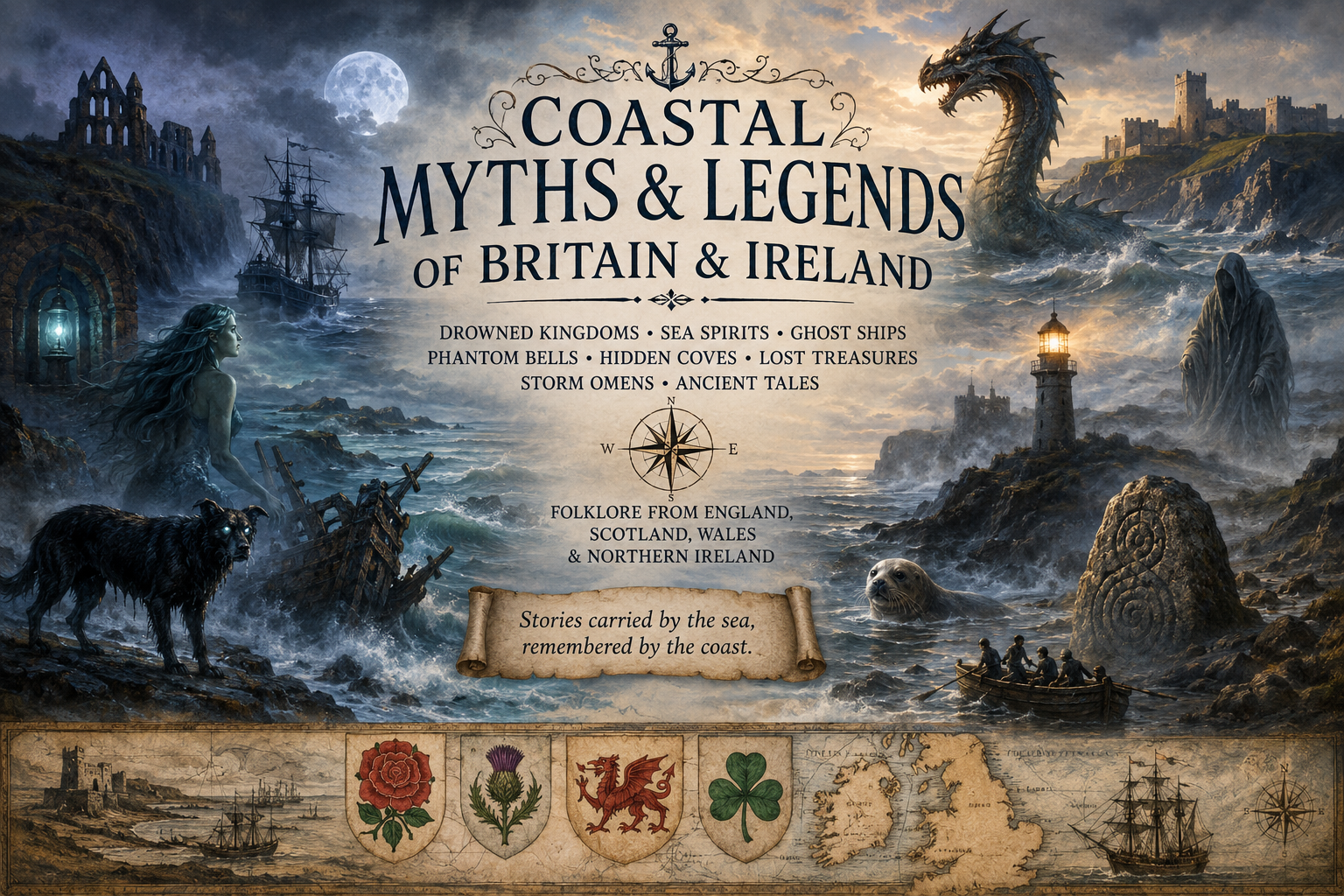


The waters off the North Highland coast, particularly those leading into and through The Minch, are long associated in maritime tradition with accounts of the so-called Blue Men of the Minch. These references are most often placed in the channel between the mainland of northern Scotland and the Outer Hebrides, a region exposed to Atlantic swell, rapidly changing weather, and complex tidal interactions. The tradition is widely recorded in oral accounts and later folkloric compilations, though its origins remain uncertain and should be regarded as cultural interpretation rather than documented occurrence.
The Minch is a broad but constricted sea channel in navigational terms, with narrowing effects between headlands and island groups that can produce strong tidal streams and localized turbulence. The approaches from the North Highland mainland—particularly in the vicinity of Cape Wrath and the entrances to sea lochs such as Loch Eriboll and Loch Broom—are subject to abrupt changes in sea state when wind opposes tide. In such conditions, steep and confused seas are common, and visibility can deteriorate quickly under low cloud, rain squalls, or sea mist driven in from the Atlantic.
Within this physical environment, the Blue Men tradition is generally described as being associated with sudden changes in conditions at sea and the perceived presence of human-like forms upon the water. Maritime writers and historians have frequently suggested that such accounts may have arisen from natural phenomena encountered in difficult navigation. These include breaking wave patterns in tidal races, foam lines formed by converging currents, and optical distortions created by low-angle light on disturbed water surfaces. In earlier seafaring periods, when passage through the Minch was undertaken in smaller vessels under sail, crews would have been particularly attentive to such visual cues.
The colour reference within the tradition is often interpreted in a descriptive rather than literal sense. Sea state under overcast skies can produce a dark, slate-like appearance, while aerated water in overfalls may appear pale or streaked depending on light conditions. When combined with fatigue, reduced visibility, and the acoustic effects of wind and breaking water in confined channels, it is understandable that mariners might have interpreted unfamiliar patterns in anthropomorphic terms. This is consistent with broader maritime traditions in northern waters, where environmental features are frequently incorporated into narrative explanation.
From a pilotage perspective, The Minch remains a significant navigation route requiring careful planning. Tidal streams can reach notable strength in constricted areas, and their interaction with Atlantic swell can produce confused seas, particularly near headlands and in the lee of islands where eddies form. Weather systems arriving from the west can bring rapid deterioration in conditions, and local shelter is limited outside designated sea lochs and harbours. As a result, timing of passage with respect to tide and weather remains an essential consideration.
Harbour infrastructure along the North Highland and Hebridean coasts is improved compared with earlier centuries, but distances between safe anchorages remain considerable. Traditional seamanship in this region placed emphasis on knowledge of tidal sets, local wind effects, and the reading of surface conditions to anticipate changes in current and exposure. In this context, the persistence of folklore associated with The Minch reflects not only cultural continuity but also the practical realities of navigation in a demanding maritime environment.
In summary, the association between the North Highland coast and the Blue Men of the Minch should be understood as part of a long-standing interpretative tradition shaped by environmental conditions. The combination of strong tides, exposed Atlantic weather, and visually complex sea states provides a credible background for the endurance of such accounts. Within pilotage practice, however, these waters are approached in terms of their known physical hazards rather than narrative interpretation, reflecting the enduring primacy of seamanship along this exposed and dynamic coastline.


Comments