
Recreating the Royal Navy Three-Tier Messdeck Bunk
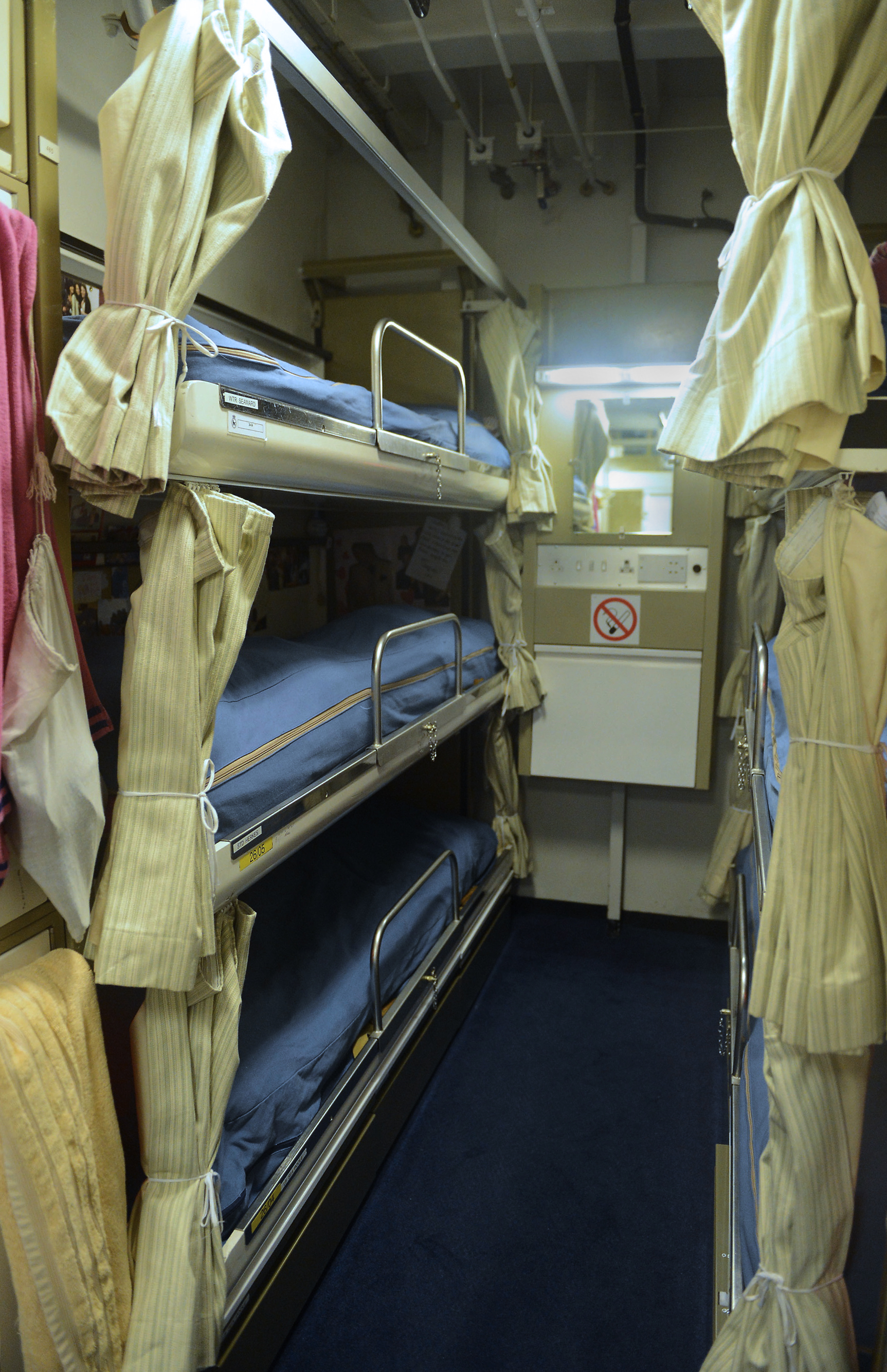
Photo: LA(PHOT) Maxine Davies, UK Ministry of Defence. Licensed under Open Government Licence v3.0 , via Wikimedia Commons.
Of all the engineering I encountered during my service in the Royal Navy, one of the most impressive examples was neither a missile system, a radar, nor a sonar console.
It was a bunk.
The photograph above shows a similar six-person berth within the Junior Rates' messdeck of HMS Northumberland, photographed (some 40 years later) on 7 January 2013 by LA(PHOT) Maxine Davies for the UK Ministry of Defence.
The standard Royal Navy three-tier messdeck bunk of the 1970s was an outstanding piece of practical engineering. Designed to occupy the absolute minimum amount of space, it transformed an ordinary messdeck seating area into sleeping accommodation for three sailors in a matter of seconds. Just as quickly, it disappeared again, leaving a comfortable communal living area with almost no indication that thirty or more men could sleep there every night.
The design solved a remarkably difficult problem.
Warships cannot afford to waste space. Every cubic foot must perform several functions, often simultaneously. A messdeck back then could serve as a dining room, a sitting room, a recreation room, an emergency shelter and sleeping accommodation, all within the same compartment. The bunk system made this possible through an ingenious combination of geometry, leverage and simplicity.
Even more remarkable was what it did **not** require.
There were no springs, no gas struts, no hydraulics, no electric motors and virtually nothing that required regular maintenance. Constructed almost entirely from welded steel frames, hinges and carefully arranged supports, the system was robust enough to survive decades of continuous naval service while remaining easy to operate, even in heavy seas.
Like thousands of young sailors, I used these bunks every day without giving much thought to their design. Only many years later, while planning the conversion of my own boat, did I begin asking myself a simple question.
"How exactly did that mechanism work?"
To my surprise, very little detailed information appeared to exist. Although generations of Royal Navy sailors slept in these bunks, I found almost no technical descriptions, drawings or explanations documenting the system itself.
This project is my attempt to change that.
Rather than simply reproducing a naval bunk, I intend to reverse-engineer the original design, explain the thinking behind it and recreate the mechanism using modern materials where appropriate while remaining faithful to the elegant simplicity of the original.
It is more than a boat-fitting exercise.
It is an attempt to preserve a small but remarkably successful piece of British engineering that quietly served generations of sailors yet seems to have passed into history almost undocumented.
Sometimes the most ingenious engineering is not found in complex machinery, but in the simplest solutions to everyday problems.
The Royal Navy's messdeck bunk is one such example.
EXTRA-008
- The UK Coastal Operating Guide
- Coastal Traditions & Maritime Culture of Britain and Northern Ireland
- Coastal Myths & Legends of Britain & Northern Ireland
Comments