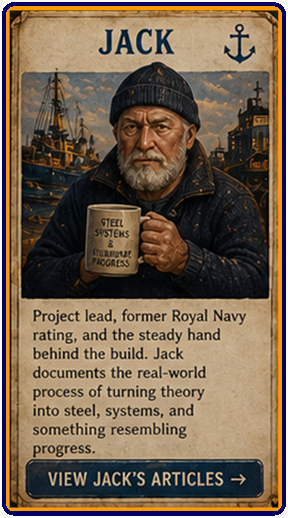
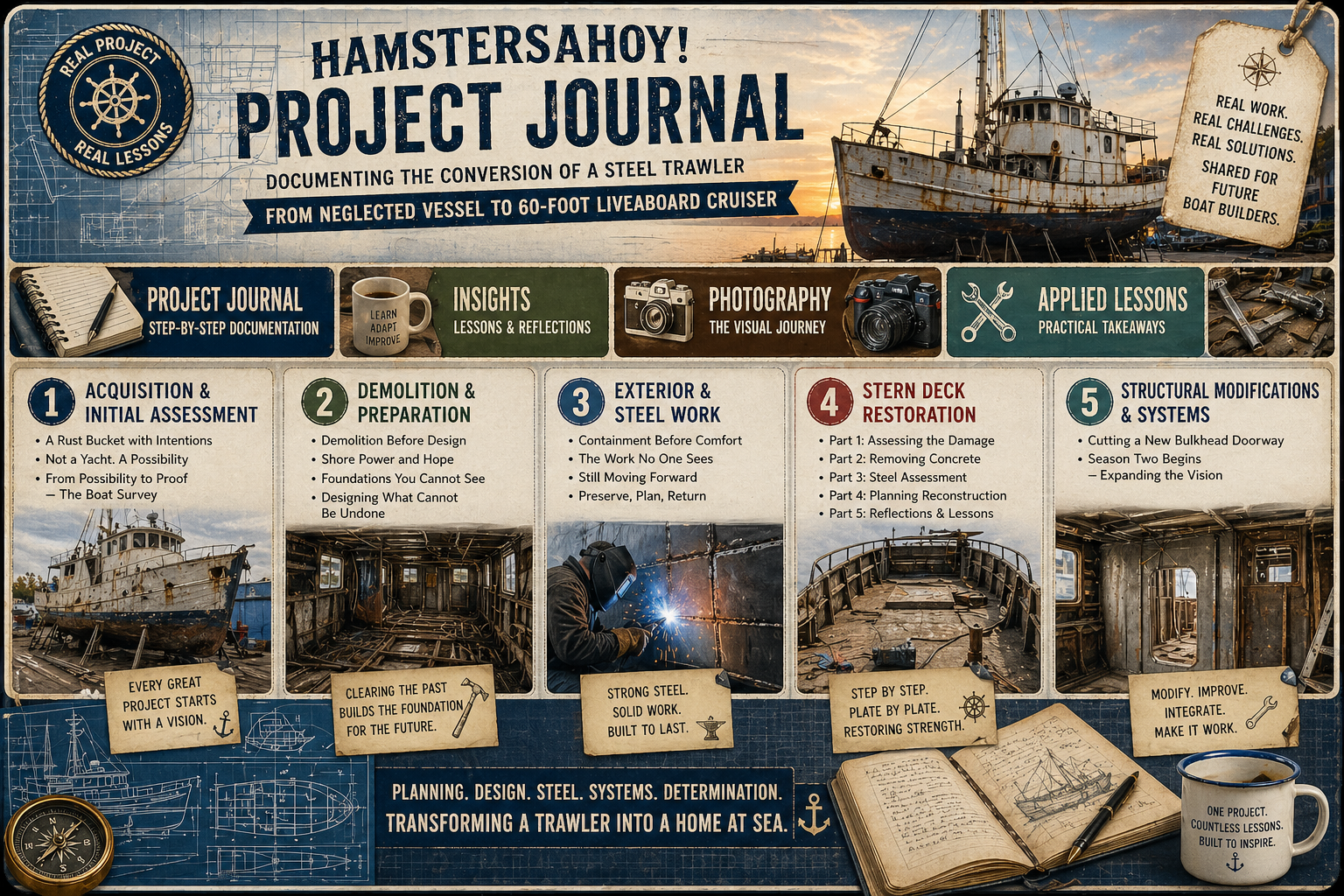

Jack Allen is the driving force behind HamstersAHOY!—the former Royal Navy seamanship rating, professional boat skipper, boat builder, and Project Manager who decided that a neglected 1980s steel trawler was the perfect candidate for a 60ft liveaboard conversion.
Every decision Jack makes is grounded in practical experience, risk awareness, and applied marine science. From hull repairs to onboard systems, he brings structure and discipline to a project that occasionally looks like chaos from the outside.
A Little About Jack
♦ Extensive experience in marine operations, project management, and construction site management
♦ Formal Natural Sciences education (Physics, Chemistry, Earth Science, Biology, Ecology, Environmental Science)
♦ RYA Day Skipper, SMSTS, Electrician, Alarms Systems Engineer, Scaffolder, Heavy Plant and Telehandler Operator
♦ Prolific writer and documenter of hands-on boating and liveaboard conversion experience
Jack and Pedro
Pedro, the slightly bewildered hamster, provides moral support and occasional perspective on the conversion project. While he cannot operate a diesel engine, Jack values the calm example Pedro sets—proof that even in a rolling anchorage, keeping perspective is critical.
Together, Jack and the team tackle the boat in stages, documenting successes, mistakes, and lessons learned. This approach ensures the project remains practical, safe, and ultimately achievable, even if the occasional absurdity creeps in.
Next in the Series
Meet the rest of the crew—some slightly more eccentric than others. Next: Esmeralda Gonzales
The low and shifting coast between Aldeburgh and Felixstowe has long carried a reputation for curious tales arising from its creeks, shingle banks and tidal reaches. Among the better-known traditions of the Suffolk Coast is that of the Wild Man of Orford, a figure associated with the waters of the River Ore and the neighbourhood of Orford Ness. Though embroidered over time by local retelling, the story has medieval origins and remains one of the more firmly rooted pieces of East Anglian coastal folklore.
The South Kent Coast has long been associated with the smuggling traditions of the Cinque Ports, whose sheltered inlets, tidal beaches and narrow river mouths provided favourable conditions for clandestine traffic across the Channel. Though often romanticised in later writing, the folklore attached to these activities is rooted in the practical realities of a hard maritime coast exposed to strong tides, uncertain weather and close proximity to the French shore. From Folkestone to Deal, and particularly around Hythe, Dungeness and the former harbour approaches of Romney Marsh, tales of concealed cargoes and nocturnal landings became a persistent part of local coastal tradition.
The Central Solent, lying between the mainland of Hampshire and the northern coast of the Isle of Wight, is one of the most heavily worked yet technically demanding stretches of water on the south coast of England. Within its western approaches, the chalk stacks known as The Needles mark the seaward end of the Isle of Wight and form a prominent but hazardous landfall for vessels entering or departing the Solent from the west. Associated maritime tradition in this area is closely tied to the practical realities of navigation rather than embellished narrative, and much of what is described as folklore arises from accumulated pilotage experience and recorded wrecks rather than isolated legend.
The coastline between Bournemouth and Christchurch carries a modest but persistent association with maritime smuggling traditions, set against a shore of shifting sands, shallow approaches, and intermittently sheltered inlets. While later popular accounts often amplify the romantic aspects of contraband trade, the historical record suggests a more practical and opportunistic activity, closely tied to the physical characteristics of Christchurch Bay and the adjoining river mouths rather than any sustained local mythology.
Lyme Bay has long carried a modest body of maritime folklore connected with its uncertain weather, heavy sea fogs and the unstable cliffs that line parts of the Dorset and East Devon coast. Unlike the more elaborate legends attached to remoter sections of the western approaches, local tradition here is generally restrained and practical in character, reflecting the concerns of fishermen, coasters and pilots working close inshore. References to warning sounds in fog, treacherous headlands and the deceptive appearance of the coast in poor visibility occur intermittently in local accounts from the eighteenth and nineteenth centuries, though many are difficult to verify in detail.
The inlets and wooded shores between Falmouth Bay and the Helford River have long carried an association with concealed trade, creek-running and the discreet movement of goods by water. Local folklore, though often difficult to separate from recorded custom, is strongly tied to the numerous coves, tidal passages and sheltered anchorages of this part of the south Cornish coast. Unlike the more dramatic legends attached to the north coast of Cornwall, the traditions here are generally practical in character, reflecting the geography of deep estuaries, narrow creeks and secluded landing places rather than tales of wrecking or invention.
The Somerset coast, facing the upper Bristol Channel between the mouth of the Parrett and the steep shores beneath Exmoor, has long carried a body of folklore concerned with drowned land, shifting shorelines and the memory of former settlements lost to the sea. These traditions are not unusual in a district shaped by strong tides, unstable estuarine margins and extensive reclaimed marsh. Alongside them appear scattered references to giants associated with prominent coastal heights and isolated headlands. Though seldom formalised into a single legend cycle, such stories have remained part of the character of the Channel coast for centuries.