
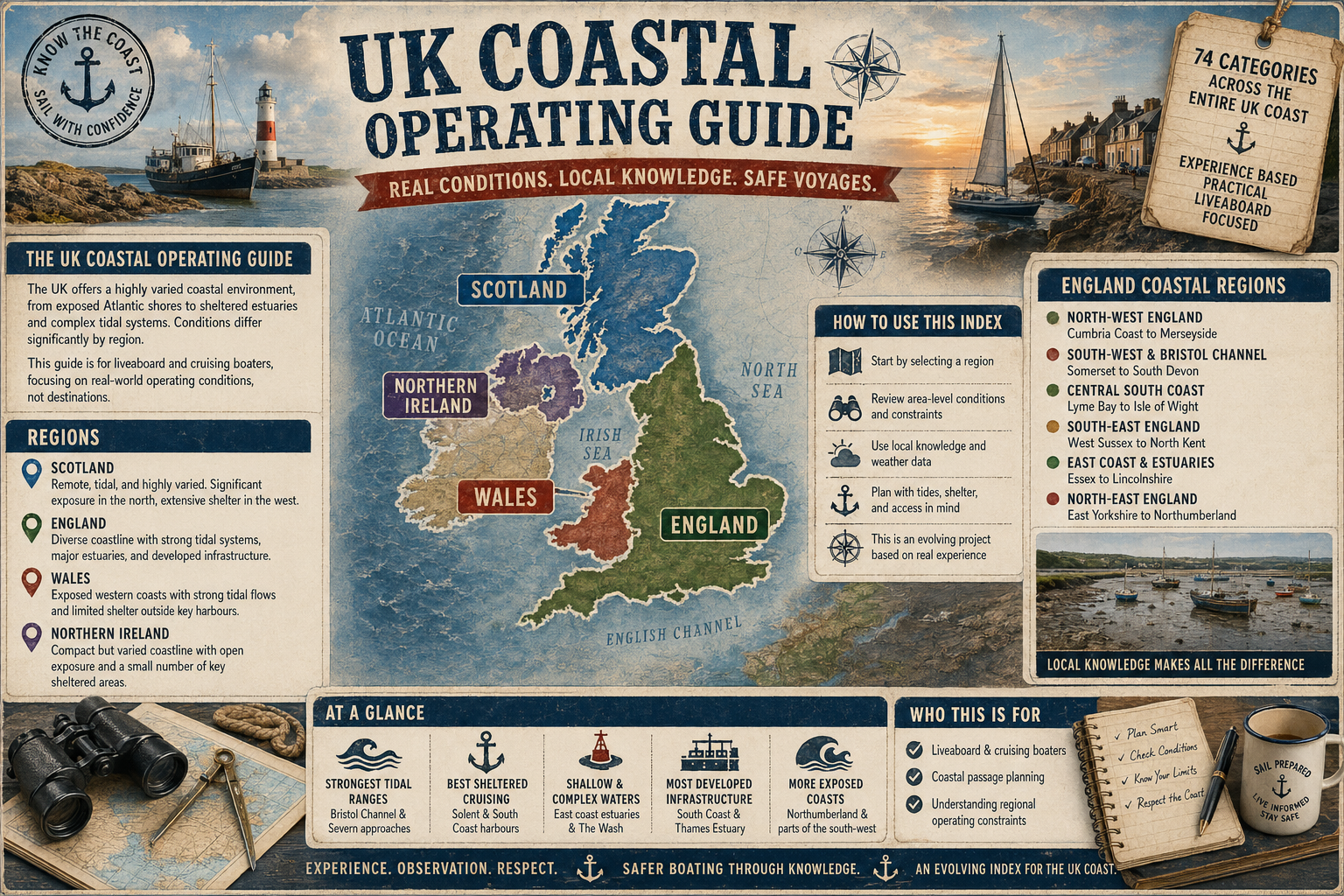
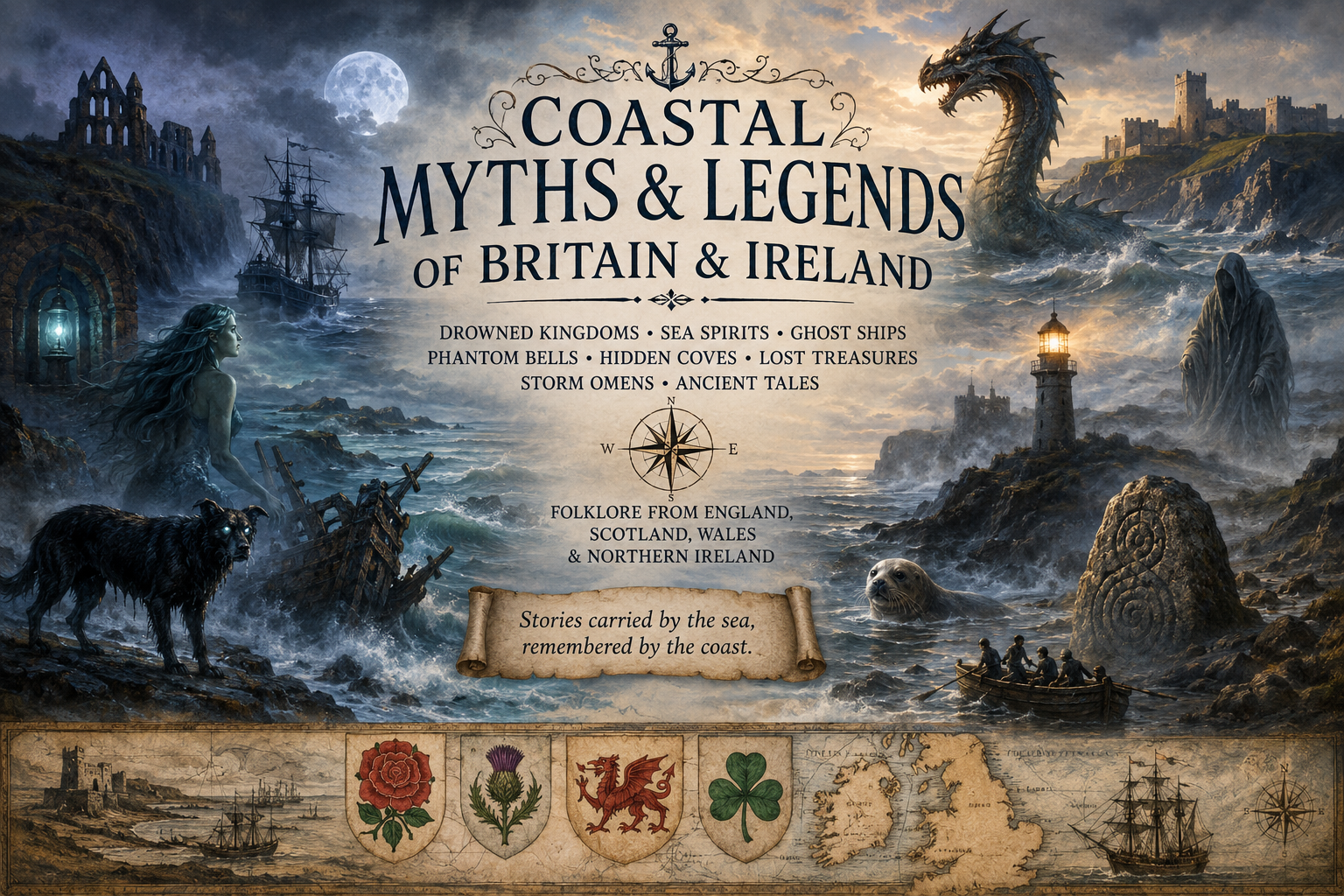



The coast of Cumbria, extending from the Solway Firth down past St Bees Head towards the fringes of Morecambe Bay, carries a modest but persistent association with northern English traditions of spectral black dogs and storm-related portents. These accounts are not strongly maritime in the documentary record when compared with other parts of Britain, yet they appear intermittently in broader regional folklore of Cumberland and the Anglo-Scottish border country. They are best understood as coastal echoes of inland belief rather than a distinct seaboard tradition, and should be treated cautiously in any historical sense.
Within Cumberland and the neighbouring border districts, tales of the “barghest” or black dog appear in various nineteenth-century antiquarian compilations and oral traditions, generally situated inland around lanes, moor edges, and river crossings. The same motif is occasionally extended seaward in later retellings, particularly in relation to the exposed and weather-sensitive shores of the Solway Firth. Here, the broad tidal flats, fast-running channels and sudden mists provide an environmental context in which spectral or omen-bearing figures were readily assimilated into local storytelling. However, direct early maritime references to such apparitions along the immediate shoreline are sparse, and it is likely that any coastal association developed secondarily.
More relevant to seafaring practice in this region is the broader northern English belief in warning signs preceding gales on the Irish Sea. Fishermen and pilots working out of Whitehaven, Workington, Maryport and the smaller Solway harbours traditionally placed greater weight on wind shifts, cloud formations over the fells, and the behaviour of tidal race and surf than on any singular apparition. Nevertheless, in oral accounts collected in the nineteenth and early twentieth centuries, the image of a large black hound or indistinct animal form is sometimes mentioned as a metaphor for approaching storm conditions, especially when sudden squalls descend from the Pennines or sweep in from the west. Such descriptions are generally retrospective and symbolic rather than observational in a literal sense.
The north-west coast itself lends a certain plausibility to the persistence of omen-based interpretation. St Bees Head, with its high red sandstone cliffs, is one of the more exposed headlands on this stretch of coast, facing directly into the Irish Sea fetch. Weather systems arriving here can develop rapidly, particularly in autumn and winter, when Atlantic depressions drive heavy swell and poor visibility. Further north, the Solway Firth presents additional hazards in the form of shifting sands and rapidly advancing tides, where local knowledge has long been essential to safe passage. In such conditions, it is unsurprising that pre-modern communities interpreted abrupt environmental changes through familiar folkloric frameworks, even if these were not strictly nautical in origin.
The idea of spectral hounds as storm indicators is more strongly rooted in wider northern English tradition, including associations with the “Gabriel Ratchets” or wild hunt motifs, though these are not consistently documented along the Cumbrian coast itself. Where such motifs do appear in coastal recollection, they should be read as part of a broader cultural vocabulary for expressing atmospheric disturbance and navigational hazard, rather than as a distinct localised belief system tied specifically to maritime practice.
Taken together, the folklore associated with black dogs and storm omens along the Cumbrian coast remains lightly evidenced and unevenly distributed, but it reflects the broader tendency of exposed northern shores to absorb inland traditions and reinterpret them in a maritime context. It forms a subdued background to navigation in these waters, subordinate to the more immediate and practical concerns of tide, wind and the often unforgiving character of the Irish Sea coastline.


Comments