
A Matelot's Sea Stories
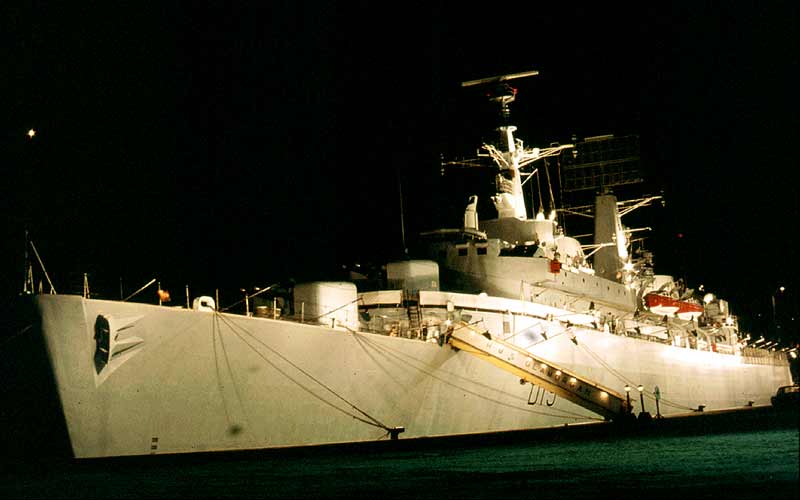
Photo: Photograph by Isaac Newton. Licensed under Creative Commons Attribution-Share Alike 2.5 Generic licence
Finding 3E Mess
It was 1973. I was fresh out of HMS Vernon. I was somewhat short of seventeen years old and I reported aboard HMS Glamorgan carrying a kitbag that seemed almost bigger than I was. Two other equally bewildered young sailors arrived with me that day and, together, we crossed the gangway into what looked - to our inexperienced eyes - less like a warship and more like a heavily armed floating skyscraper.
*Glamorgan* was a County-class guided missile destroyer, bristling with missiles, heavy guns, anti-submarine weapons, a Wessex helicopter and a crew of 230 hard-nosed sailors. She looked enormous. Before very long, however, we would discover that despite all her size, space aboard ship was one of the rarest commodities imaginable.
We were directed, with little ceremony, to the Ship's Office somewhere below decks. That meant our first introduction to the Royal Navy's ladders, hatches and passageways, all while wrestling kitbags that seemed determined to throw us backwards down every companionway we encountered. By the time we finally arrived, we stood in complete silence, each privately wondering whether volunteering for this had really been such a brilliant idea.
The silence did not last.
The Master-at-Arms appeared.
To a nervous sixteen-year-old he seemed less like a man and more like a force of nature. Conversation around the office stopped instantly at the sound of a single command.
"BUTTON IT!"
Everyone did.
He glanced at my Draft Chit from HMS Vernon with all the warmth of a tax inspector examining a forged banknote. Without a word, he scribbled something indecipherable on a Perspex board, produced my Station Card and pushed it into my hand before dismissing me just as efficiently as he had processed me.
Three bunks. Three lockers. First of Starboard Watch.
That, apparently, was all I needed to know.
We were pointed towards a framed plan of the ship and given our next instruction.
"Find it. Memorise it. Read Daily Orders before you move."
There was to be no guided tour, no friendly escort and certainly no welcoming committee. We were now officially part of the ship's company and expected to find our own way.
Eventually, after much wandering, wrong turns, climbing, descending and muttered frustration, we found 3E Mess deep in the forward part of the ship.
The Leading Hand checked our names, pointed at three bunks and three lockers that appeared already occupied, then wandered off, leaving us wondering what happened next.
Fortunately, someone else arrived.
Able Seaman Geoff Dixon.
"Dixie", as everyone knew him, had been appointed our Sea Daddy. Whether he had volunteered for the job remains doubtful, but from that day onwards he became our guide through the realities of life at sea.
The Royal Navy taught us our trade at HMS Vernon.
Dixie taught us how to be sailors.
He explained the routines nobody wrote down, corrected our mistakes before they became disasters, answered the questions we were too embarrassed to ask and occasionally administered what today might politely be described as robust encouragement.
Looking back after more than fifty years, I owe him far more than I probably realised at the time.
One demonstration has remained with me ever since.
He walked over to what appeared to be an ordinary steel-framed settee.
Three seconds later it had become a fully made three-tier bunk.
Three seconds after that it was a settee again.
I remember simply standing there staring at it.
For a teenager who enjoyed understanding how things worked, it was one of the cleverest pieces of practical engineering I had ever seen. At the time I simply accepted it as another part of everyday naval life.
Half a century later, while planning the conversion of my own boat, I realised I had never forgotten it.
That remarkable bunk system deserves a story of its own.
EXTRA-007
Comments