
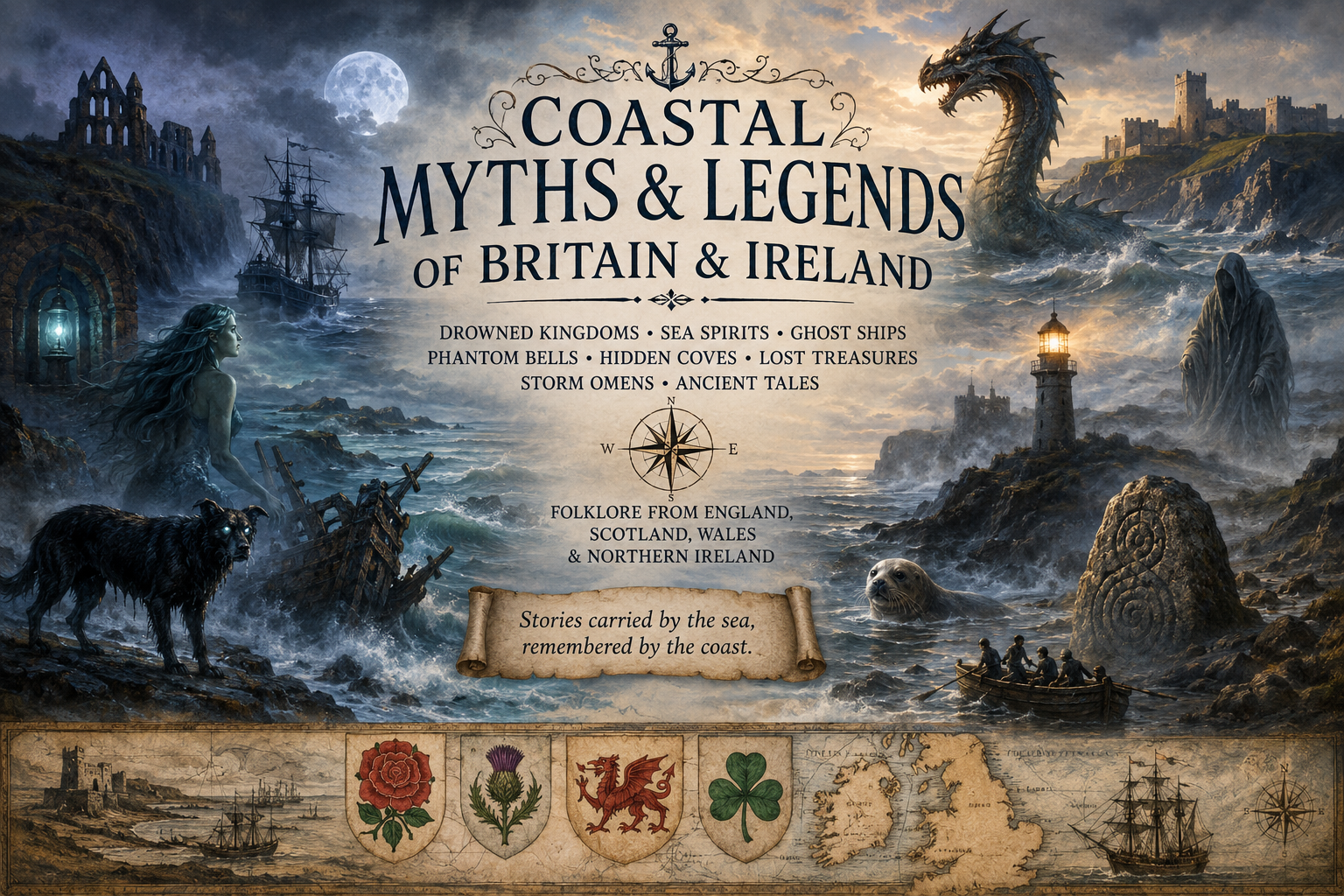


The western coasts of Cornwall have long been associated with the tradition of Lyonesse, a supposed drowned territory said to have occupied waters between Land’s End and the Isles of Scilly. Although the story belongs chiefly to oral tradition and later medieval romance, it remains one of the strongest maritime folk associations in the far south-west approaches. Along the North Cornwall coast, particularly among older fishing communities and seafaring families, references to the lost land persisted well into the nineteenth century as part of local coastal lore rather than formal history.
The legend varies considerably in detail. In most accounts Lyonesse was described as fertile low country containing settlements, churches and grazing land, submerged by a catastrophic inundation. Some versions place the event within historical time, while others leave it undated. No reliable historical evidence exists for such a territory on the scale later imagined, though the tradition may preserve distant memory of coastal flooding, changing shorelines and the gradual encroachment of the sea upon low ground after earlier periods of lower sea level. The isolated granite heights of the Isles of Scilly, lying beyond the western approaches, are thought by some historians to have encouraged such beliefs, particularly in poor visibility or heavy Atlantic weather when landforms appear altered by haze and sea state.
For mariners working the north coast from Hartland Point towards Trevose Head and beyond, the Lyonesse tradition formed part of a wider respect for the exposed nature of these waters. The Atlantic swell reaches the coast with little interruption, and the combination of strong tidal streams, overfalls and submerged rock ledges has long contributed to the severe reputation of the Cornish seaboard. Between Pentire Point, Bedruthan Steps and the approaches towards Cape Cornwall, the coastline presents high cliffs broken by narrow inlets and small harbours vulnerable to weather from the west and north-west. In such conditions, stories concerning drowned country and vanished settlements acquired a natural place within local maritime memory.
Among fishermen there existed occasional references to church bells supposedly heard beneath the sea in calm weather, particularly after heavy swell or during periods of unusual stillness. Such accounts were never universal and were often repeated cautiously rather than asserted as fact. Similar traditions occur elsewhere around the British coast and are generally regarded as folkloric embellishments attached to dangerous or changeable waters. In Cornwall the motif became closely tied to Lyonesse, especially in districts maintaining long cultural links with Celtic tradition and the sea.
The legend also held practical associations with seamanship. Coastal pilots and harbourmen were acutely aware of the reefs extending offshore around the western extremities of Cornwall and Scilly. Long before modern buoyage and electronic navigation, these dangers were interpreted through accumulated local knowledge, frequently reinforced by story and custom. Oral traditions concerning lost ground beneath the sea may have served partly as cautionary material for younger fishermen and boat crews unfamiliar with Atlantic conditions. The sea routes west of Padstow and north of St Ives Bay were historically exposed to rapid deterioration in weather, and vessels embayed against a lee shore often found little shelter once committed.
Harbours along the North Cornwall coast, including Boscastle, Port Isaac and Padstow, preserved many fragments of seafaring tradition in which the sea was regarded as both provider and continual hazard. Within that setting, Lyonesse endured less as a fixed narrative than as a symbol of the uncertain boundary between land and ocean. The broad estuary of the Camel, the surf-beaten cliffs near Tintagel, and the tidal races beyond the headlands all contributed to a maritime landscape where stories of drowned country remained credible in spirit, even where the details were doubted.
Today the tradition survives chiefly as part of Cornwall’s historic coastal identity. Though unsupported by archaeology in its more dramatic forms, the legend of Lyonesse continues to reflect the character of the western approaches: exposed, weather-bound and shaped at every point by the Atlantic sea.


Comments