




Crofting harbours and Atlantic fishing traditions
The coastal culture of North Highland is closely associated with crofting communities, working harbours and fisheries adapted to Atlantic and northern waters. From the sea lochs of north-west Sutherland to the harbours of Caithness, crofting and fishing have often formed complementary parts of the local economy. The pattern varies between districts, but the practical relationship remains evident in boat use, harbour work, fish handling and local knowledge of tides, weather and sea conditions.
In north-west Sutherland, places such as Kinlochbervie developed in communities where fishing supplemented crofting. Fishing became increasingly important during the nineteenth and twentieth centuries, including through the movement of fishermen from the east coast. The modern harbour at Kinlochbervie was developed at Loch Bervie in the twentieth century and became an important whitefish port. Shellfish fishing continues alongside larger commercial vessels. The harbour remains a working centre for landing, handling and dispatching catches.
Farther east, Wick represents a different phase of northern fishing history. Its harbour was developed in the early nineteenth century as the herring fishery expanded. Wick subsequently became one of the principal herring ports of northern Britain, with seasonal fleets, curing and associated shore trades. The herring fishery declined during the twentieth century, followed by the growth of whitefish fishing and other commercial fisheries. Today the port supports a smaller fishing sector, including landings of shellfish and other species.
Scrabster, on Thurso Bay, retains an important connection with fishing and inter-island transport. The harbour developed during the nineteenth century as a fishing and ferry port and became an established route towards Orkney. Its modern fishery includes whitefish and shellfish, supported by landing, market and marine-service facilities. The harbour illustrates the continuing division of work around a northern fishing port, where fishing, transport, engineering and shore services operate together.
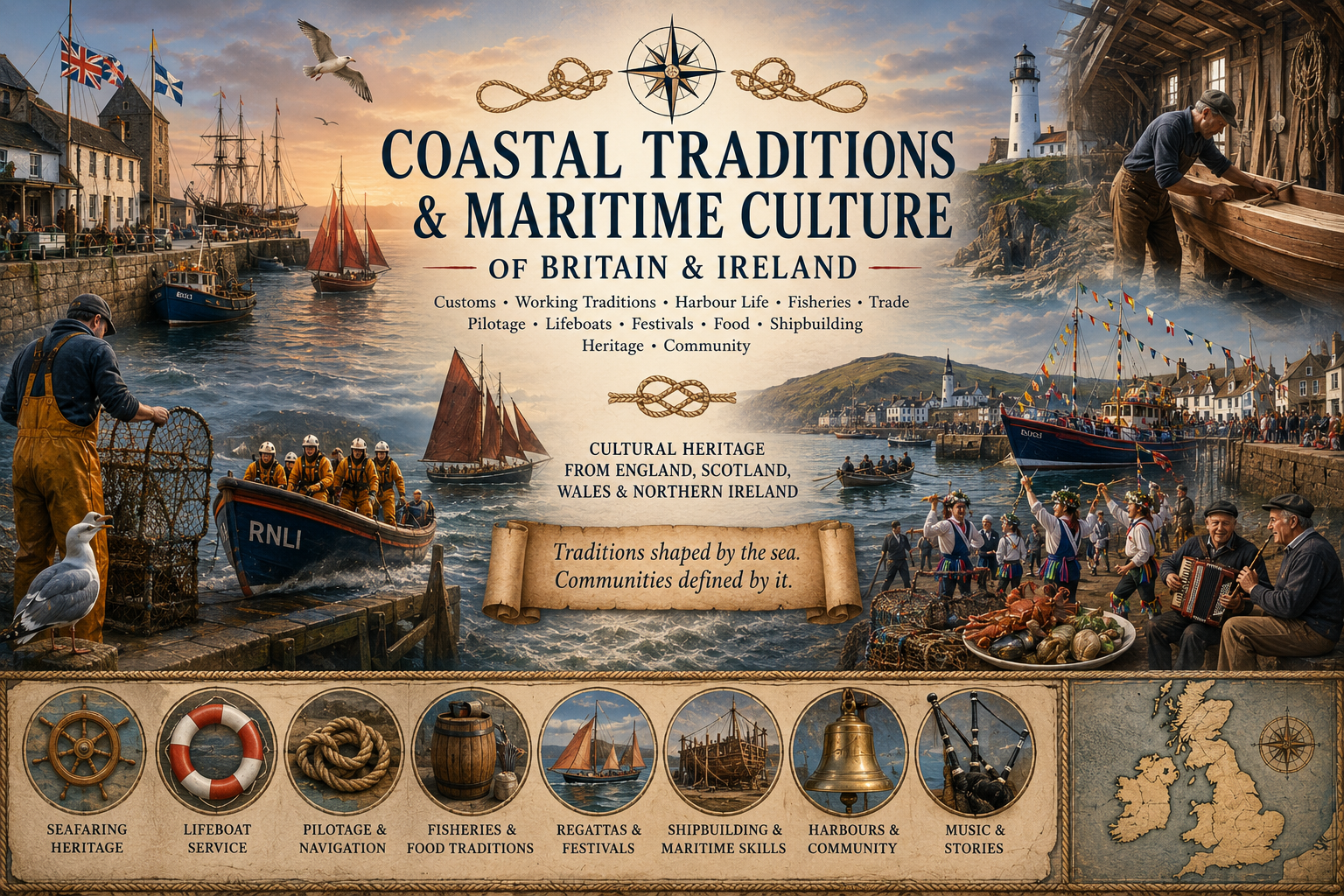
Harbour customs in North Highland are principally working practices rather than formal ceremonial traditions. The preparation and maintenance of boats, handling of nets and gear, landing and sorting catches, and movement of fish ashore have traditionally required close cooperation between crews and shore workers. Seasonal fishing once brought substantial temporary populations to ports such as Wick, while in smaller settlements fishing remained more closely integrated with crofting households. The balance between these activities varied considerably along the coast.
Rescue at sea forms another continuing element of local maritime culture. Before organised lifeboat services became established, fishermen, pilots and coastguards were frequently involved in assisting vessels in difficulty. Caithness has long-established RNLI stations at Thurso and Wick, reflecting the hazards associated with exposed approaches, harbour entrances and rapidly changing sea conditions. Lifeboat work remains an active part of the region's maritime life, rather than simply a historical association.
Modern continuity is most apparent in the working harbours themselves. Fishing fleets are smaller than during the herring and post-war whitefish eras, but commercial landings, shellfish operations, harbour maintenance and marine services continue at several ports. For the mariner, the coastal culture is consequently best understood through these active functions: crofting communities linked to shore access, boats working local and offshore grounds, and harbours serving as places of landing, repair, supply and communication. The earlier fishing economy has contracted, but its practical influence remains evident in the organisation and everyday use of North Highland's coastal waters.
- The UK Coastal Operating Guide
- Coastal Traditions & Maritime Culture of Britain and Northern Ireland
- Coastal Myths & Legends of Britain & Northern Ireland
Comments